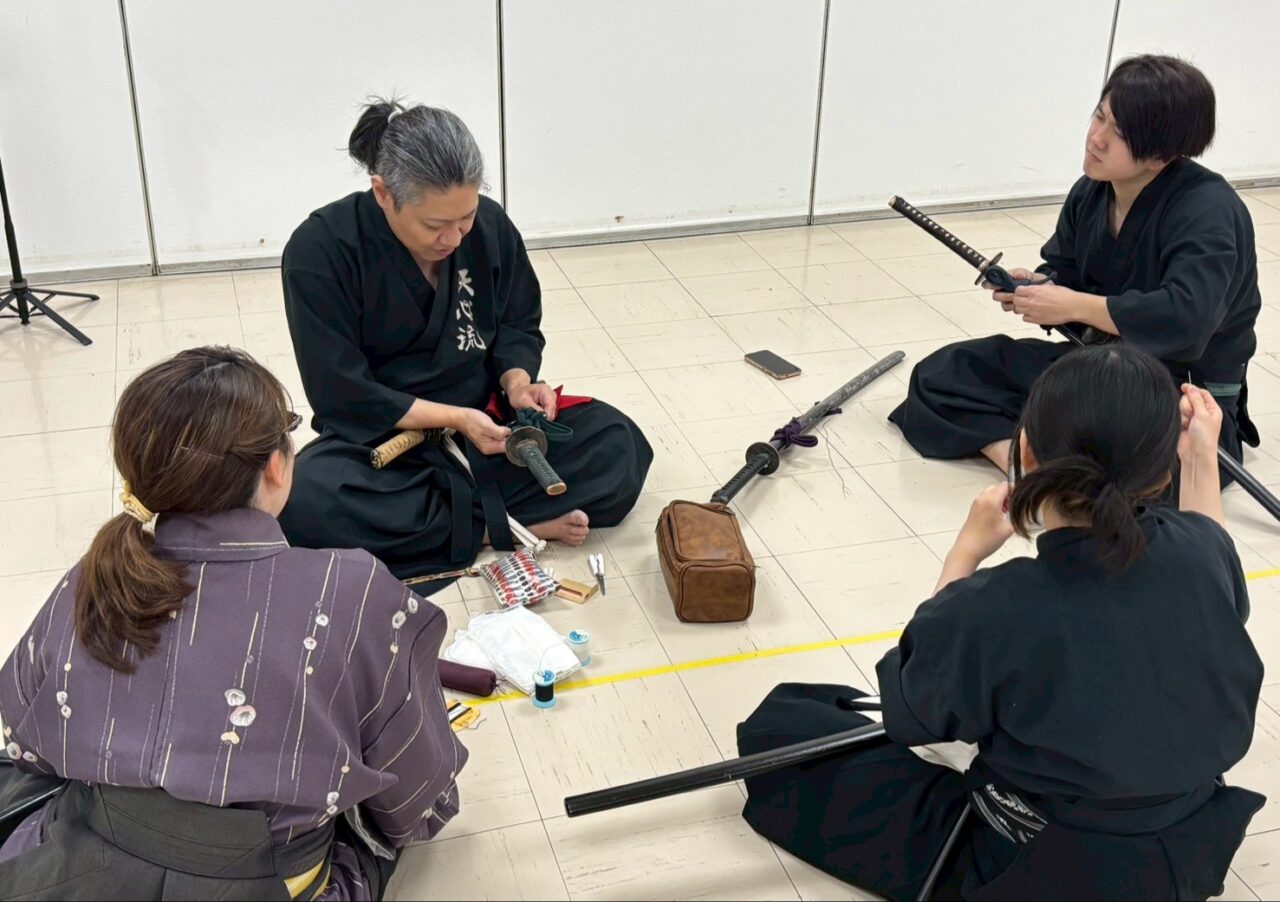
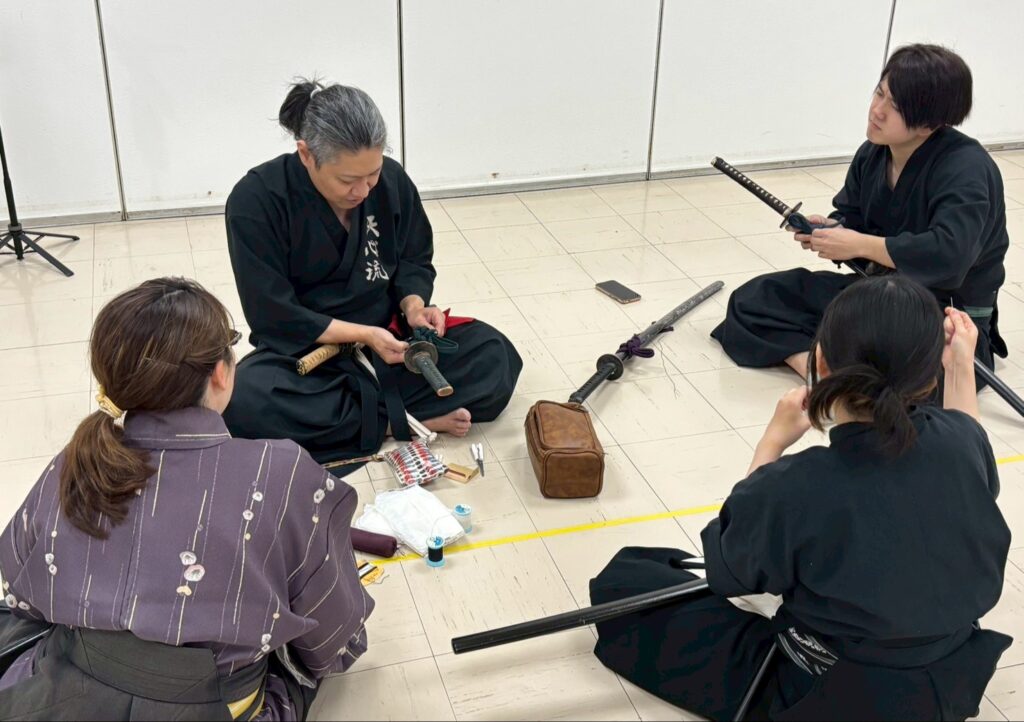
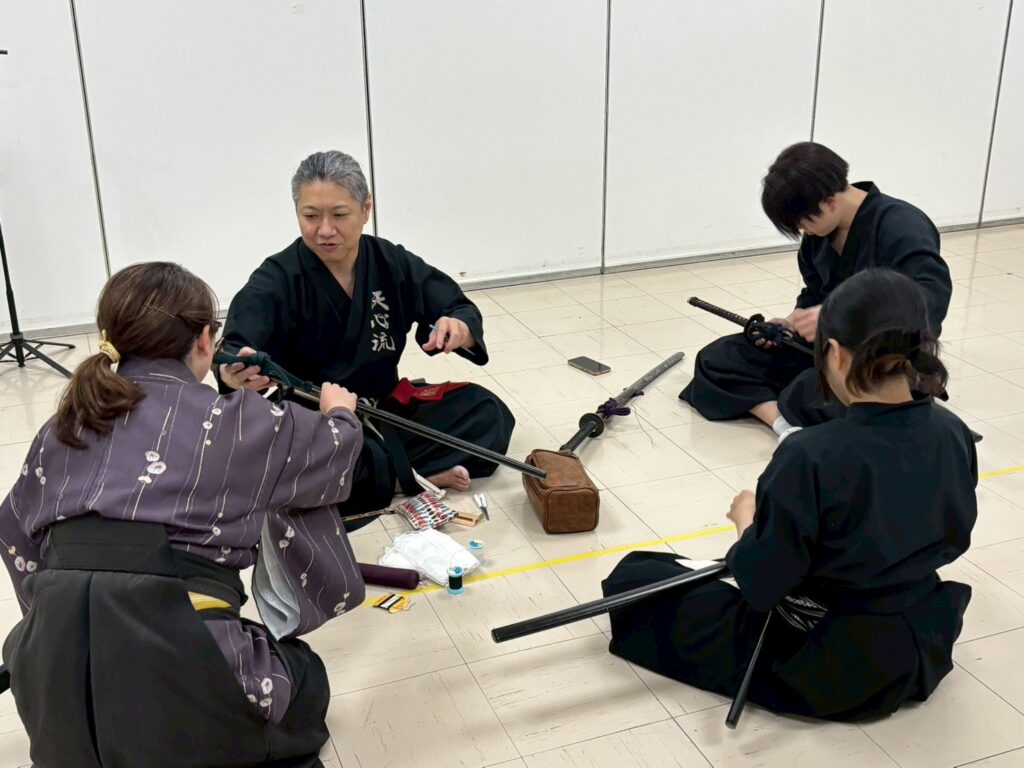
A scene of sewing.
There is a principle when sewing the sageo to ensure that it does not come undone unintentionally.
When necessary, a slightly stronger pull will snap the thread and allow it to be undone.
There are also principles for when the sageo 下緒 is not tied, but intentionally untying something and it coming undone by accident are entirely different matters. Moreover, a loosened sageo can become unexpectedly troublesome.
(There are separate principles for handling such situations.)
In Tenshin-ryu, as part of the cultivated refinement of high-ranking samurai, the sageo of the long sword is, in principle, tied in a kochō-musubi (butterfly knot, commonly known as a bow knot).
This practice originates from the tachi-o of the jindachi. In times of peace, the cord was tied, signifying that “the tachi is not suspended by wrapping the cord around the waist.”
Conversely, leaving the tachi-o untied indicated that the sword could be hung at any moment, implying a state of readiness and tension.
To reflect a peaceful world—and also because, unlike the tachi, an uchigatana mounting is worn by being inserted directly into the belt, making it unnecessary to leave the sageo untied and hanging—the sageo is always secured, in accordance with the etiquette expected of high-ranking samurai.
Although the sageo appears intricately and beautifully arranged when tied, it can be quickly undone in an emergency and used for a variety of practical purposes.
If things of this nature—those dismissed as “you can understand it without doing it” or “it’s simple”—are neglected and not actually practiced, they will gradually be lost.
Unless one acts immediately upon being told, one ends up becoming someone who merely “knows” without experience—top-heavy with knowledge alone.
Accessing an online recipe website is not the same as actually cooking.