On the Debate Over Whether to Call Someone “Shishō” or “Sensei”
For many years, certain people within the classical martial arts community have expressed opinions along these lines:
“Modern koryū (classical Japanese martial arts) have become little more than cultural or recreational classes.
Disciples no longer respect their masters, treating them as mere teachers.
Such people are not true disciples, but simply students.
Without genuine, heartfelt respect for one’s master, it is impossible to truly master a traditional art.
People who merely imitate the outward forms, without ever touching upon the essence of the tradition, are nevertheless awarded ranks and certificates of transmission.
This is precisely what the Japanese proverb means when it speaks of creating a Buddha statue without giving it a soul.
Mass-producing students who are little more than hollow imitations is effectively the same as reducing classical martial arts to empty forms and contributing to their decline!”
Such arguments have existed in certain circles for quite some time.
However, the terms Sensei and Shishō themselves did not necessarily carry the clear hierarchical distinction during the Edo period that some people insist upon today.
In modern society, opportunities to formally study under a master—to become someone’s disciple, or shiji suru (師事する), an expression that itself feels almost obsolete—have become relatively uncommon. Consequently, the word Shishō has acquired a particularly weighty significance.
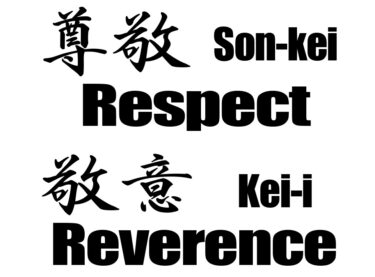
Yet in ancient China, the term Sensei (先生) literally referred to someone who had been born before another person. Over time, it also came to designate a teacher or master. In this respect, its development was not particularly different from its usage in Japan.
There was also the contrasting term Kōsei (後生), literally meaning someone born later, or a younger person.
The well-known phrase “Kōsei osorubeshi” (後生畏るべし), from the Analects of Confucius, expresses the idea that younger generations should never be underestimated.
Interestingly, while Shishō generally refers to one’s own master, the world of rakugo (traditional Japanese comic storytelling) has a custom of addressing performers who have attained the rank of Shin’uchi as Shishō, even when they belong to entirely different lineages.
I wonder when that particular custom began.
Incidentally, in the world of koryū and Japanese budō, we are sometimes told that failing to address a teacher from another school as Sensei is disrespectful.
Yet in certain dōjō, people become furious if you call someone from another school Sensei when you have never actually studied under that person!
So what on earth are we supposed to do?
The word Seito (生徒), meaning student, is much the same.
It was already used in ancient China and has a long history in Japan as well. It continued to be used during the Edo period to refer to people receiving instruction, with meanings that overlapped those of Deshi (disciple) and Montei (a member of a master’s school).
Certainly, there is the expression “Shitei wa Sanze” (師弟は三世), referring to the belief that the relationship between master and disciple extends across three lifetimes, and that their bond is even stronger than that of family.
The medieval Japanese instructional text Dōjikyō (童子教) contains the following passage:
一日師不疎 況数年師乎
師者三世契 祖者一世眤
弟子去七尺 師影不可踏
“Do not neglect even someone who has been your teacher for a single day; how much less should you neglect a teacher who has instructed you for many years.
The bond between master and disciple extends across three lifetimes, while the ties of ancestry extend across only one.
A disciple should maintain a respectful distance from the master and must never tread upon the master’s shadow.”
Yet at the same time, rather casual and informal master-disciple relationships also existed during the Edo period.
A master-disciple relationship did not necessarily imply such an exceptionally profound bond.
Certainly, the more deeply one devotes oneself to learning something, the greater one’s mastery is likely to become.
However, when it comes to preserving and transmitting a cultural tradition, there are limits to what can be sustained by passionate devotees alone.
Many mature cultural traditions depend not only on their most devoted enthusiasts, but also on much larger numbers of casual or less actively committed participants.
Among practitioners of koryū, there are many who hold what could be described as a somewhat elitist worldview, or who advocate maintaining only a small number of supposedly exceptional practitioners.
Yet for koryū, which is already a minor and relatively obscure part of society, such an approach does not necessarily produce an elite.
It simply produces a small number of people.
Promotion is often inadequate, the general public remains unaware that these traditions even exist, and opportunities to study them are limited.
This is not merely a problem of the present day. Since the Meiji period, the circumstances surrounding the survival and continuation of classical martial arts have hardly ever been favorable.
Of course, the direction of each tradition is a matter for that tradition itself to decide, and it is not our place to interfere in the affairs of other schools.
However, at Tenshinryu, we have undertaken every possible measure to overcome these circumstances since I first entered the school in 2008.
Naturally, all of these efforts have been carried out on the condition that our traditions are preserved.
And yet, as illustrated by the arguments quoted at the beginning, ideas that are not necessarily traditional at all have become widely accepted, both among the general public and within the classical martial arts community itself.
Correcting these misconceptions and communicating the historical realities are also responsibilities that we must undertake as part of our public outreach.
This is because we have repeatedly been subjected to severe criticism based on incorrect information.
Furthermore, there are many people who believe such misinformation and readily accept these misguided criticisms without questioning them.
Those who are more devoted to slandering others than to improving their own knowledge and skills often invest enormous amounts of time and effort into doing so.
By contrast, when we devote ourselves to genuine study, practice, and self-improvement, responding to such attacks naturally becomes a lower priority.
Engaging these people in endless arguments is little more than a waste of time.
Nevertheless, it remains essential to counter misinformation by spreading accurate knowledge and fostering a correct understanding of our traditions.