Since ancient times, Japan has had forms of etiquette performed by prostrating oneself on the ground. These were apparently known as Kirei (跪礼), Kifukurei (跪伏礼) or Hofukurei (匍匐礼), among other names.
Today, all of these are generally referred to as dogeza (土下座).
In the video work “THE JAPANESE TRADITION ~Nihon no Katachi~” by the comedy duo Rahmens, dogeza is presented in a deliberately twisted, comical way. In a sense, dogeza may have become a symbol of Japan’s old-fashioned culture.
I also came across this online. It seems dogeza has evolved even further in recent years.
I look forward to it becoming an international competitive sport someday. Incidentally, take one step further and it apparently becomes dogene (土下寝), lying flat on the ground. Its origin is unclear, but it seems to be fairly well known as an advanced form of dogeza.
About Dogeza
Dogeza is performed prostrate on the ground. The 地 (ground) here means 土 (earth), so it is fundamentally something done outdoors.
Today the image of dogeza as an apology is firmly established, but in the past it was by no means used only for apologies. It was simply one of the forms within formal etiquette. In paintings of battles, for example, we see figures prostrating themselves before a warlord seated on a shōgi (床几, a folding camp stool).
There is the idea that looking down on a superior while bowing is disrespectful. Another important idea is that, as part of samurai etiquette, one makes one’s submission clear by deliberately placing oneself in a restricted position. Even where a lord–retainer relationship already existed, showing every courtesy was the proper attitude of the samurai as a man of war (ikusabito, 軍人).
That may sound grandiose, but prostration of this kind is not unique to Japan. In neighbouring China, the sanki kyūkōtō (三跪九叩頭, “three kneelings and nine knockings of the head”) is known as the rite subjects performed before the Qing emperor. One places both hands on the floor and strikes the forehead against the ground three times as one set, repeated for three sets in total.
Fuhai (伏拝, bowing down in worship) is likewise a custom seen not only in Asia but around the world. Through the long process in which apes, then early hominins and finally modern humans acquired a fully upright posture, deliberately lowering oneself to the ground to show reverence may be a behaviour rooted in human instinct. (In the animal world too, making oneself small is a sign of submission, so its roots may go back even further.)
It is not clear when this came to be called dogeza, but Tenshinryu Hyoho does not use the term. In Tenshinryu, when sitting on the ground outdoors, we use a seated posture called Yagura-za (矢倉坐), with the toes of both feet raised and the knees opened.
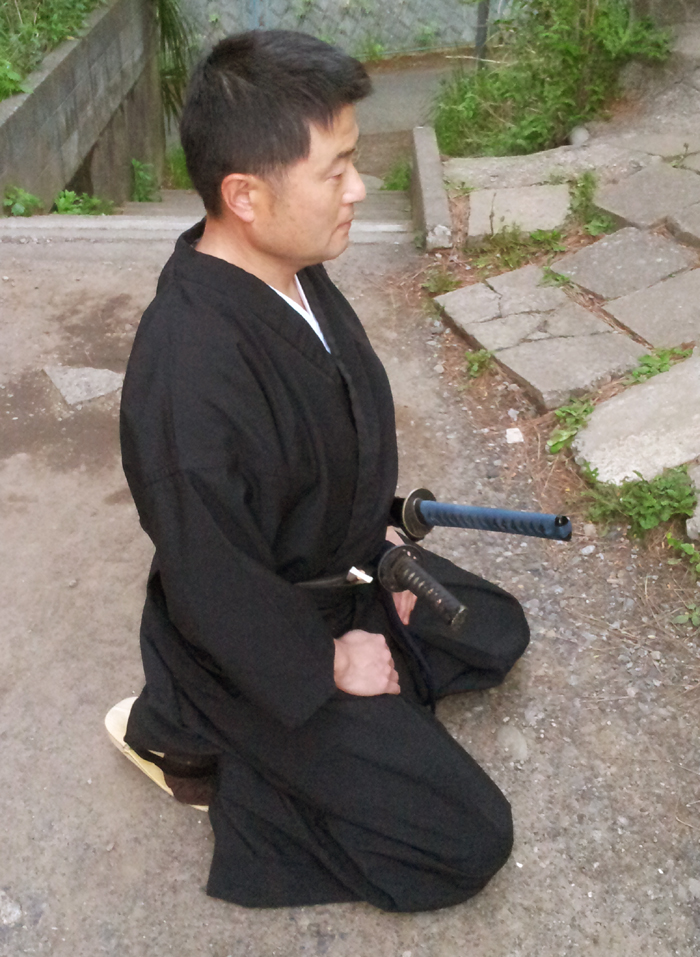
Yagura means a wooden watchtower. Kneeling on one knee (oriishiki) or crouching (sonkyo) may also be used, but these are informal forms. In the presence of, or beside, a person of high rank, one basically waits in Yagura-za. Kneeling on one knee and crouching are postures from which one can act at once. By bending both knees, one shows that one is paying respect.
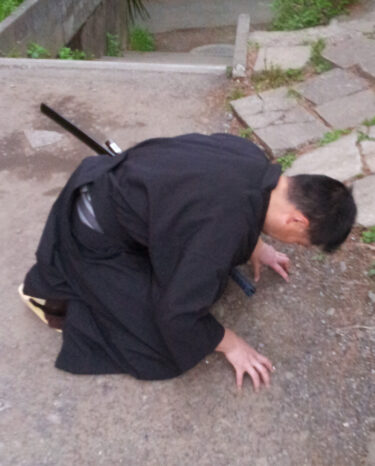
Because this bow is performed from Yagura-za, we call it Yagura-rei (矢倉礼). This is what is commonly called dogeza. In Tenshinryu, the hands are placed with all five fingers raised so that the palms are not soiled.
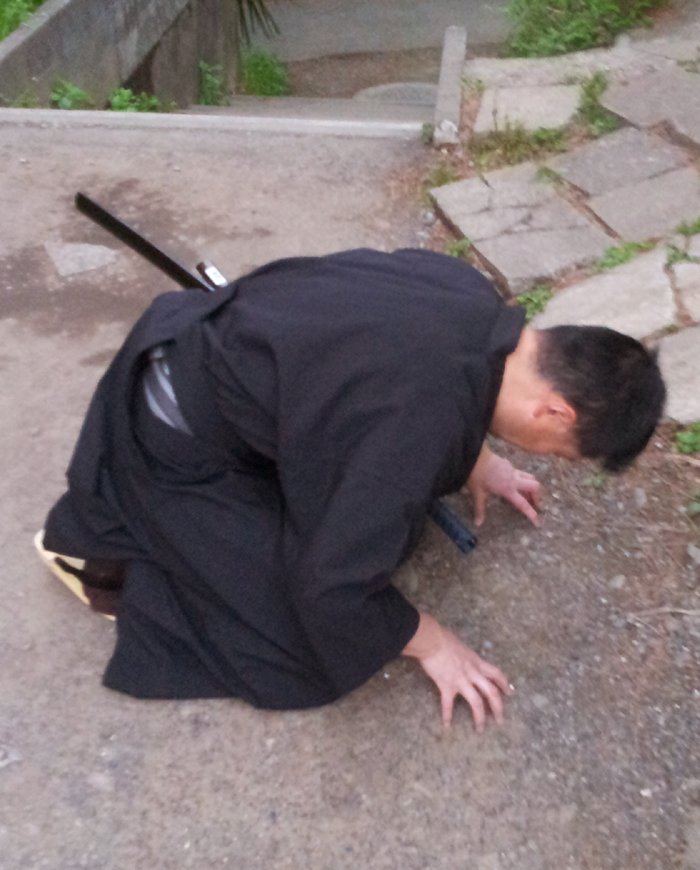
It may be a little hard to see in the photo, but the five fingers of both hands are raised like claws. The shape is similar to the “Hawk’s Claw pose” from the anime Secret Society Hawk’s Claw (秘密結社 鷹の爪), where the characters strike this pose while groaning “Ta-ka-no-tsu-me…”.
Today, dogeza tends to be seen as the symbolic apology pose mentioned at the beginning. In reality, it is a formal Japanese form of etiquette handed down since ancient times, an indispensable courtesy in warrior society, and by no means an undignified posture. Of course it is also used for apologies, but considering it as part of Japan’s traditional culture, it is a pity that it spreads, abroad and in Japan alike, only as a self-deprecating comic symbol that exaggerates this one aspect.
The Meiji Restoration abolished the class system and created a society of equality among the four classes, and the Constitution of Japan later established equality under the law. From the perspective of the egalitarian society humanity has achieved, traditional etiquette such as Yagura-rei may have been seen as a remnant of the class system, something to be shunned, and degraded under the label of clownishness.
Yet this is where the roots of modern etiquette lie. The traditional etiquette that Japan has cultivated is, I believe, an etiquette of the heart that still speaks to us today.
Such ancient customs (kojitsu, 故実) tend to be discarded as anachronisms. But if the traditions of the warrior class are rejected, the necessity behind the many techniques devised on that foundation is lost as well. That is why Tenshinryu, however anachronistic it may seem, considers it our mission to learn these traditions as they are and to pass them on to future generations as living transmission (jitsuden, 実伝).
About Zarei (Seated Bows)
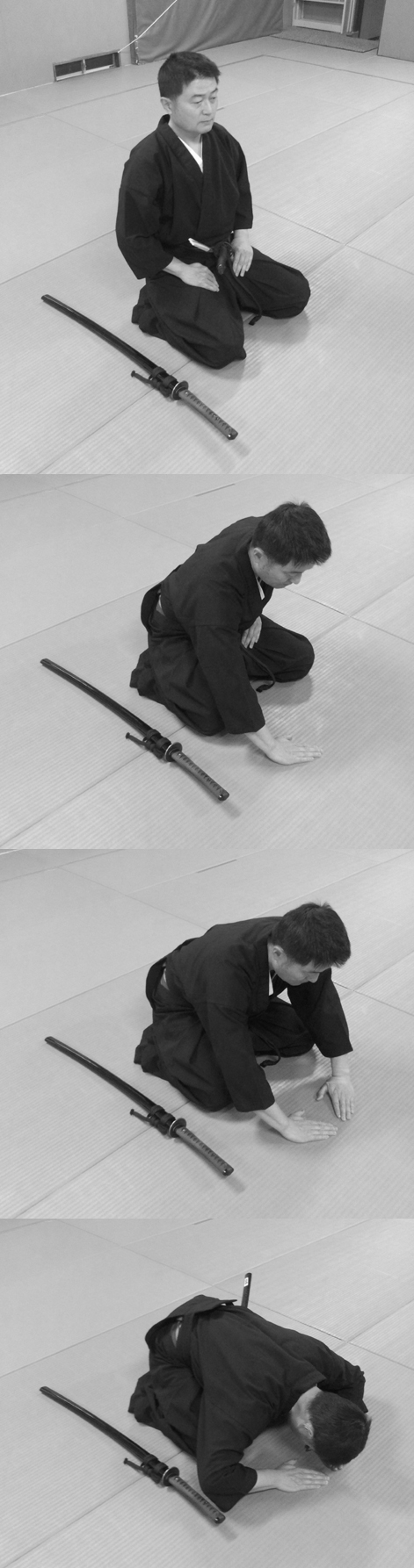
That was the story of dogeza. A mistake we often see is calling a seated bow performed indoors on the floor “dogeza”. As explained above, dogeza is strictly something done outdoors on the earth. What is performed on tatami or a wooden floor is a zarei (坐礼), a seated bow. Even people who study Japanese budō and martial arts are often surprisingly unaware of this difference.
In Japanese tradition, people sat directly on the floor indoors, without chairs. This way of living is called yukaza or tokoza (床座, floor-sitting).
In formal etiquette, greeting a seated person while standing means looking down on them. This is why the Japanese custom of valuing seated bows arose. For samurai who wore swords in particular, etiquette was a serious matter that could not be taken lightly.
Many forms of bow were established to suit time, place and occasion. Tenshinryu uses eight kinds of seated bow: Mokurei (目礼), Shurei (首礼), Shikenrei (指建礼), Sesshurei (折手礼), Takushurei (拓手礼), Sōshurei (双手礼), Gasshurei (合手礼) and Gasshōrei (合掌礼). (As older forms, we also use Sōkōrei 爪甲礼, Tekōrei 手甲礼 and Sonkyorei 蹲踞礼, among others.)
The Ogasawara-ryū school of etiquette also appears to have nine bows, known as kuhonrei (九品礼): Shurei, Mokurei, Shikenrei, Sōkōrei, Sesshurei, Takushurei, Sōshurei, Gasshurei and Gasshōrei. However, as the saying goes, a different school means different manners. There are subtle differences from Tenshinryu’s etiquette, and even a bow with the same name, such as Gasshōrei, can be entirely different.
The bows most often mistaken for dogeza are Sōshurei and Gasshurei. In both, one places both hands in front of one’s own knees and lowers the head. The difference is that in Sōshurei only the palms touch the floor, while in Gasshurei the forearms, from the palms to the elbows, rest on the floor. In Gasshurei the hands are also placed slightly further forward. Because of this, Gasshurei is a deeper bow than Sōshurei.
A Japanese Tradition
Whether indoors or outdoors, a prostrating bow could easily become a servile, undignified posture for a samurai. In such a precarious posture, the samurai preserved their dignity, kept their bearing correct, and perfected a kind of formal beauty. In Tenshinryu, we believe this tradition of seated bows, full of grace and dignity, is something Japan should be proud to show the world.
Come to think of it, we hardly ever have a chance to learn how to bow properly or to study etiquette. In the Edo period, Ogasawara-ryū, the etiquette of the warrior class, spread through its students to townspeople, merchants and farmers. Warrior etiquette became the foundation of Japanese upbringing. Today, however, there is almost no opportunity to learn even a standing bow correctly, let alone a seated one.
Etiquette is not mere form, but you cannot break a form without first knowing the basic form. Not knowing the form does not make you a form-breaker (katayaburi); it makes you formless (katanashi). Perhaps “THE JAPANESE TRADITION ~Nihon no Katachi~”, mentioned at the beginning, works as comedy precisely because a correct form exists. Tenshinryu hands down the real “Japanese tradition”.
Of course, Tenshinryu’s purpose is not to teach warrior etiquette. We teach the etiquette transmitted in our Style only because our kata require it. Yet in the years ahead, I believe such etiquette will become an important teaching for anyone who wants to come into contact with Japan’s traditions and establish their own identity.
— Kuwami Masakumo, 10th Shike (Grandmaster) of Tenshinryu Hyoho
Original Japanese article: 坐礼と土下座の違いについて